

Boat Safety Rules, Lake Etiquette & Navigation Tips
On Lake Wallenpaupack, boats are limited to 45 mph from sunrise to sunset on weekends and holidays from the Saturday before Memorial Day through Labor Day, and 25 mph between sunset and sunrise.
The lake has no horsepower limit, but the speed rules still apply.
Know These Rules Before You Go
Speed and no-wake rules
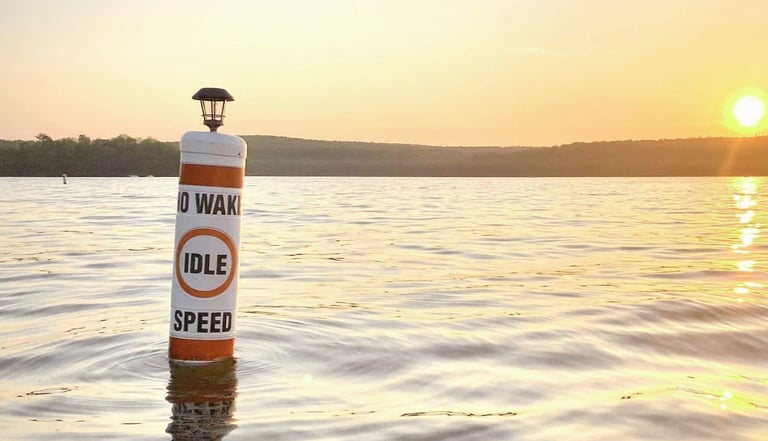
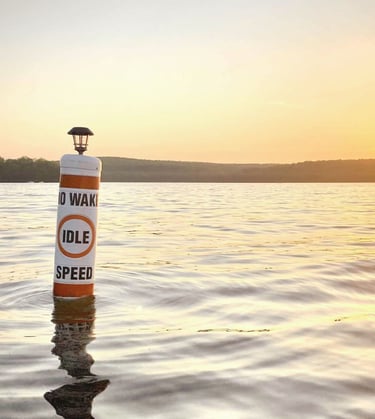
Pennsylvania requires slow, no-wake speed within 100 feet of shorelines, docks, launch ramps, swimmers, waders, and anchored, moored, or drifting boats and floats.
Pennsylvania also prohibits operating faster than slow, no-wake when within:
100 feet behind another boat underway
50 feet to the side of another boat underway
Additional slow, no-wake areas, including:
Wallenpaupack Creek
From Ledgedale Bridge to about 1,000 feet downstream
From the dam to about 600 feet south
Between Cairn’s Island and the Pike County shoreline
Life jackets
Children under 12 must wear a USCG-approved life jacket at all times while underway on boats 20 feet or less. From November 1 to April 30, everyone on boats less than 16 feet (including kayaks/canoes) must wear a life jacket.


Registration, Permits & Licenses
In Pennsylvania, a Boating Safety Education Certificate is required for all personal watercraft operators and for anyone born on or after January 1, 1982, who operates a boat powered by more than 25 horsepower.
Quick Guide for what you'll need:
Motorized boat
- Needs current boat registration
Kayak, canoe, paddleboard, rowboat, inflatable, or other unpowered boat
- Needs registration and/or displayed launch permit at access areas
Jet ski / PWC
- Needs proper registration, and the operator may need a Boating Safety Education Certificate
Fishing
- Age 16+ needs a valid Pennsylvania fishing license
Fishing for trout
- If your planning to fish for trout, you need a trout permit
Common Mix-Ups:
A launch permit is not the same as boat registration
A boating safety certificate is not the same as registration
A fishing license does not cover trout by itself if a trout permit is required
What You'll Need for the Lake:
Registration card or launch permit
Boating safety certificate, if required
Fishing license, if fishing
Trout permit, if needed
Passing another boat? You yield. The boat doing the overtaking is the give-way boat.
Who Yields on the Lake?
Boat on your right? Slow down or give way. In a crossing situation, the boat ahead and to your right is usually the stand-on boat.
Meeting head-on? Both boats should turn right.
Sailboat vs. powerboat? The powerboat usually yields to a sailboat under sail only.
Jet skis / PWCs do not get special right of way. They follow the same basic give-way and stand-on rules as other power-driven vessels.
Nobody gets to “win” the situation. Even if you technically have the right of way, both operators must act to avoid a collision.
Fishing boats do not automatically have right of way just because they are fishing. Give them space and slow down near them, especially if lines may be out, but normal navigation rules still apply unless a boat is truly restricted in its ability to maneuver.
Where to Get Gas on the Lake
Lighthouse Harbor Marina has a gas dock with posted hours of 9:00 a.m. to 5:00 p.m. daily.
1st Klas Marina & Ironwood Recreation also offer gas dock and refuel service.
Always call ahead. Especially if you'll need relying on fuel late in the day, hours can change by season and weather.
Emergency Help on the Lake
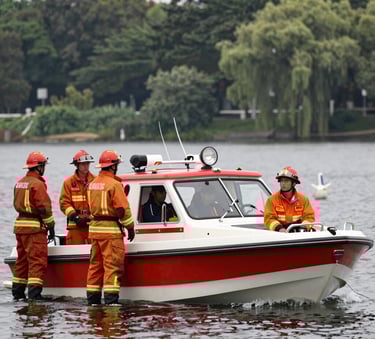
For a true emergency on the water, call 911 first. The Pennsylvania Fish and Boat Commission’s Northeast Region Law Enforcement office, which covers Pike and Wayne Counties, lists (570) 477-5717.
What to tell dispatch
Your location on the lake
The closest marina, bridge, island, or landmark
Boat type and color
Whether anyone is injured or in the water
Frequently asked questions
Do sailboats have the right of way?
Usually, yes. A power-driven boat must generally give way to a sailboat under sail. But if the sailboat is overtaking another boat, the sailboat is the give-way vessel. In every case, both operators still have to avoid a collision.
What should jet skiers know?
Personal watercraft operators must wear life jackets, use required safety gear, and cannot operate from sunset to sunrise. They should watch for swimmers, tubes, tow ropes, anchored boats, and larger boat wakes. All PWC operators must have a Boating Safety Education Certificate with them.
How do you pass another boat on the lake?
If you are overtaking another boat, you are the give-way boat. Pass wide, stay predictable, and do not throw a hard wake. Pennsylvania also restricts speed when you are close behind or beside another moving boat.
Is it okay to cut directly across the lake?
Yes, in open water, but do it carefully and predictably. Sudden moves across busy traffic are what create problems. A clean, readable path gives other boaters more time to react. This is an inference drawn from the state’s navigation and safe-operation rules.
Do I need a boating license?
Pennsylvania does not issue a general “boating license,” but some operators do need a Boating Safety Education Certificate. That includes all jet ski operators and anyone born on or after January 1, 1982 operating a boat with more than 25 horsepower.
Do I need a fishing license?
Yes, if you are 16 or older and fishing public waters. Keep it accessible on paper or digitally.
Boats anchored within 100 feet of the shoreline are in a "special anchorage area" and have specific lighting requirements to ensure they are visible to other boaters at night